Lightning protection zone concept
The LPZ concept according to IEC 62305-4:2010 makes it easier to plan, implement and monitor comprehensive protection measures.
In this approach, the building is subdivided into zones with different risk potentials. Based on these zones, the necessary lightning and surge protection devices and components are determined.
Modern structures and buildings are becoming smart. They are based on a variety of networked technical components: Building management, telecommunication, control and security systems to name but a few. Failure of individual technical building equipment components can have far-reaching consequences and even bring the entire building to a standstill.
Although external lightning protection protects people and material assets in buildings from the risk of fire, it does not protect the electrical and electronic systems from failure due to surges caused by lightning discharge. The principle of lightning protection zones (LPZs) according to IEC 62305-4 describes effective protection against surges caused by lightning electromagnetic impulses (LEMPs).
According to this principle, the structure to be protected must be divided into inner lightning protection zones according to the risk level posed by the LEMP. Suitable LPZs can be defined depending on the number, type and sensitivity of the electronic devices / systems.
Lightning protection zone concept
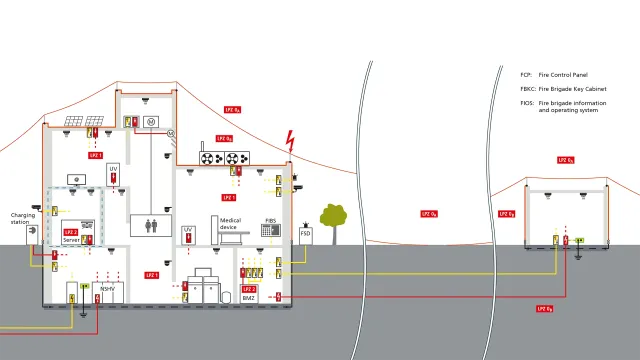
Outer zones
LPZ 0A:
Zone at risk from direct lightning strikes and the unattenuated electromagnetic field of lightning. The systems affected, such as lines extending beyond buildings, may be subjected to the full lightning current.
LPZ 0B:
Zone protected against direct lightning strikes, but where the threat is the unattenuated lightning electromagnetic field. The systems affected, such as alarm lights or sirens, may be subjected to partial lightning currents.
Inner zones
LPZ 1:
Zone in which impulse currents are limited by current sharing and by protective devices at the zone boundaries. Spatial shielding may attenuate the lightning electromagnetic field. Ring lines with detectors are often installed in LPZ 1.
LPZ 2-n:
Zone which, compared to LPZ 1, is additionally protected against impulse currents and the lightning electromagnetic field and is therefore subject to less interference.
Categories of surge protective devices
According to the requirements and loads placed on surge protective devices, they are categorised as lightning current arresters, surge arresters and combined arresters.
The highest requirements are placed on the discharge capacity of lightning current arresters and combined arresters used at the transition from lightning protection zone 0A to 1 or 0A to 2. These arresters must be capable of conducting partial lightning currents of 10/350 μs wave form without being destroyed in order to prevent the ingress of destructive partial lightning currents into the electrical installation of a building.
At the transition point from LPZ 0B to 1 or downstream of the lightning current arrester at the transition point from LPZ 1 to 2 and higher, surge arresters are used to protect against surges. Their task is both to reduce the residual energy of the upstream protection stages even further and to limit the surges induced or generated in the installation itself.
Downloads
TGA
DEHN protects technical building equipment