Product data determines whether you win projects
Structured product data is essential for tenders, documentation and building operations. Providing it at an early stage makes coordination simpler and lays the groundwork for informed decisions. A Digital Product Passport (DPP) is a central source of this information and includes the Product Carbon Footprint (PCF), which quantifies a product's CO2 emissions. It gives you direct access to reliable product data at any time.


Why the way product data is handled is changing
Product data is no longer just a minor technical detail. Three developments have made it much more important in projects today.
Regulations
Whether it's the CSRD (Corporate Sustainability Reporting Directive) or the EU Ecodesign Regulation, reliable product data is increasingly a prerequisite for projects, tenders and reports.
Market requirements
Building owners, planning engineers and operators must provide evidence of their sustainable decisions. Without structured, robust product data, this becomes a hurdle – if you don't have documented data, you can't score points or win contracts.
At the same time, practical information such as dimensions, weights and installation data must be readily available in day-to-day project work.
Competition
Searching for data sheets manually takes up valuable time. If you can provide product information in a matter of seconds, you'll stay competitive and win contracts. If you have to search for documents or submit them later, you'll waste time and miss out on projects.
What exactly are the DPP and PCF?
The Digital Product Passport and the Product Carbon Footprint are interlinked: the DPP is a central source of product data, and the PCF is a key part of it. Put simply, the DPP provides access to the information, and the PCF uses it to generate a key sustainability indicator.
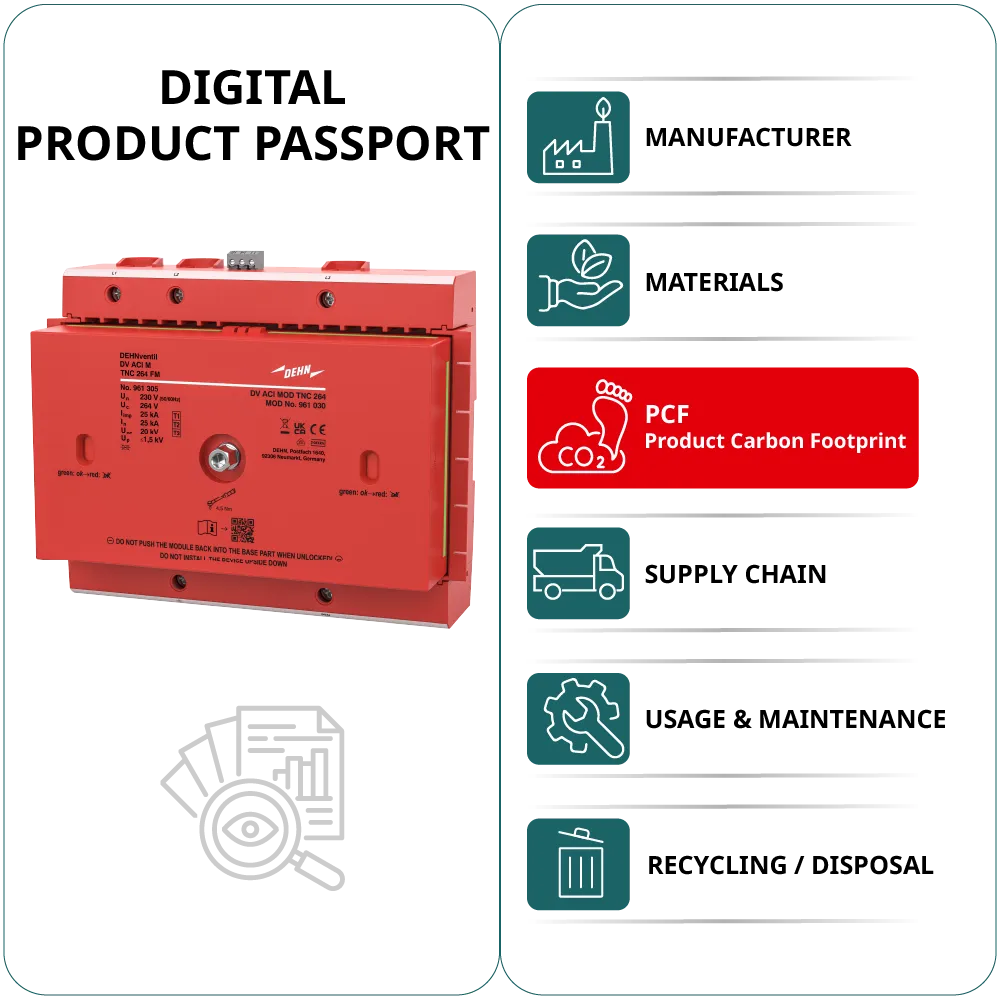
Digital Product Passport: access to structured product data
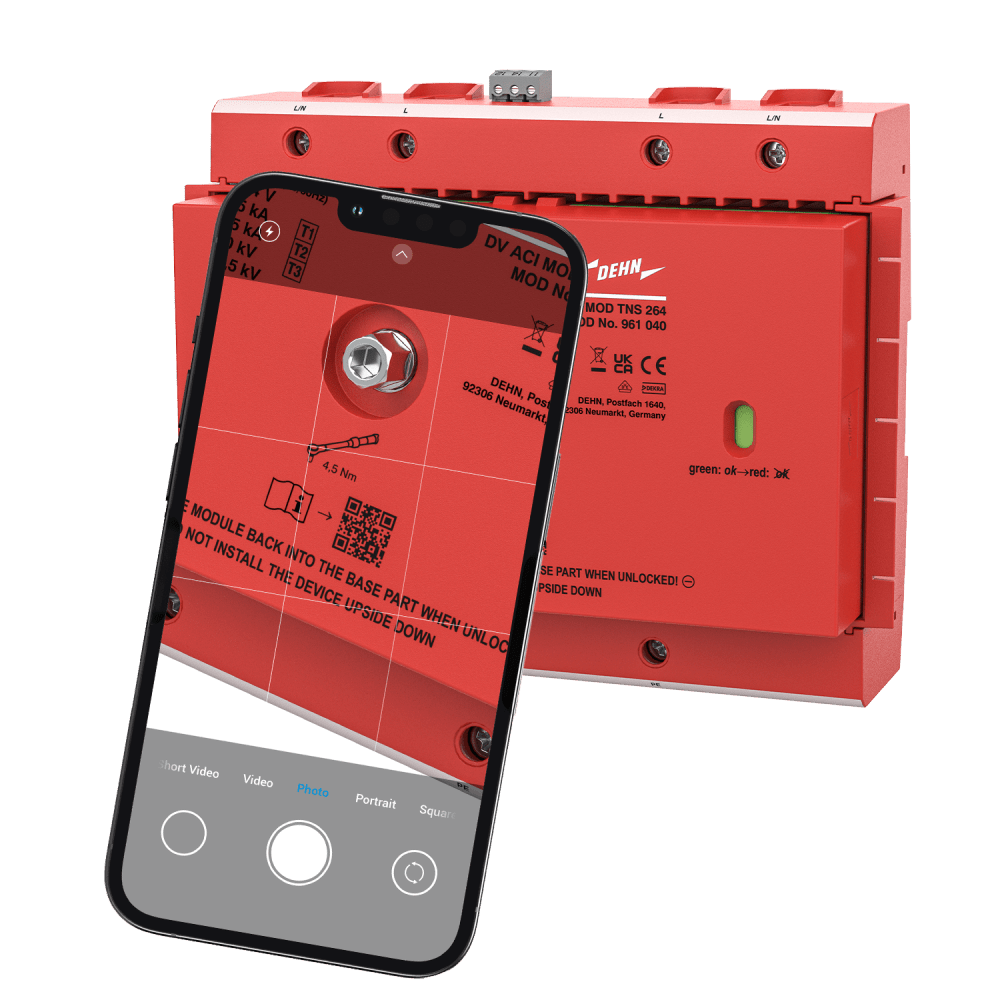
The Digital Product Passport brings together all relevant information about a product – in a structured, up-to-date format and, in the case of DEHN products, directly accessible via a QR code.
This information includes:
• Basic product information, such as details of materials and fabrics
• Raw material extraction, processing and delivery information
• Usage information, such as installation instructions
• Environmental and sustainability data, including the PCF or recycling information
Product Carbon Footprint – transparent and useable
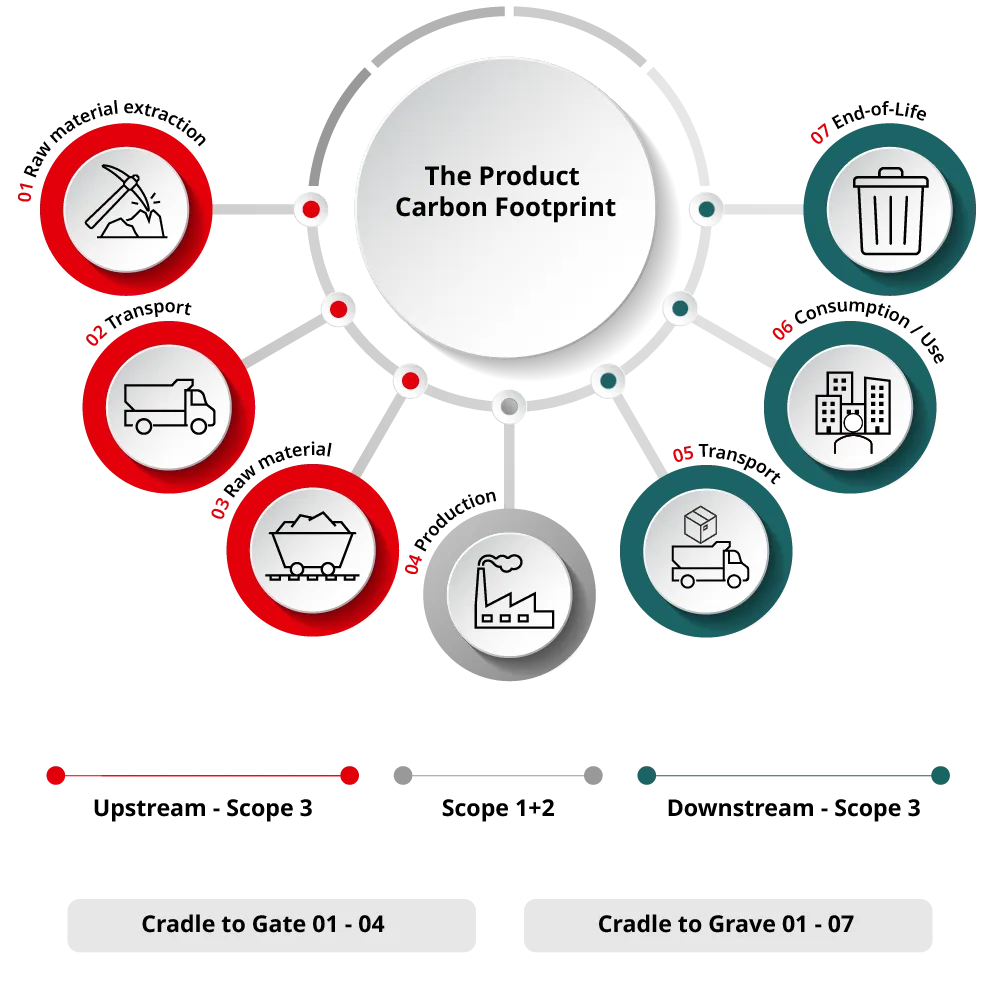
The PCF maps a product's CO2 emissions across defined life cycle stages. This starts with the extraction of raw materials, covers the manufacturing process of the product, and includes its transport, use and disposal. The values are calculated in accordance with established standards and documented transparently in the PCF.
Advantages for you: you can compare products in terms of their carbon footprint, justify decisions and know that you are meeting sustainability requirements.
Accessing the DPP is easy
To access the DPP:
1. Scan the QR code on the product using your smartphone camera.
2. Open the Digital Product Passport. The language is detected automatically.
3. All relevant data is available immediately. There's no logging in, no app and no lengthy searching.
How you benefit from the Digital Product Passport
Real-world use cases
How the PCF and the DPP help specific tasks relating to planning, tendering and operations.
Purchasing: Access reliable product information faster.
All relevant product data is available at any time, without the need to search or make enquiries.
Technology: Transparency through verifiable data.
Product information is documented and verifiable – no assumptions, no uncertainty.
Sustainability: Sustainability and compliance requirements under control.
Relevant data such as PCF, RoHS and REACH is available in a structured format and can be used immediately.
Good quality: Better decision-making in projects.
Products can be compared directly, and all relevant information is available.
The database: substantiated, not merely asserted
The data is calculated and provided based on recognised standards such as ISO 14067, validated procedures and independent assessments. This creates a solid foundation you can rely on for planning, tendering and operations.
Award:
EcoVadis – Silver
Top 15% of all assessed companies

Standard-compliant:
PCF as per ISO 14067
CO2 emissions based on scientific evidence

Partnerships:
Fraunhofer IBP
Scientific partner for PCF calculation
Sustainability standard:
Annual sustainability report
From the 2025/26 financial year onwards, in accordance with the VSME standard

Supporter:
UN Global Compact
Member since March 2024

Audits:
DIN EN ISO 14001 and 50001
Certified management systems for the environment and energy
Speak to the people behind the data
Corporate Sustainability

Digital Product Passport

Product Carbon Footprint

Any questions?

FAQs on DPPs and PCFs
The Product Carbon Footprint (PCF) is particularly relevant for companies that track CO₂ emissions transparently, need to meet ESG requirements, and want to manage sustainability data throughout the supply chain. Reliable PCF data primarily benefits procurement departments, ESG departments and project management teams.
PCFs in procurement
- Comparison of suppliers based on standardised emissions data
- Integration of sustainability criteria into tenders
- Preparation for customer requirements and ESG documentation
- Improvement of transparency in the supply chain
PCFs for ESG and sustainability
- Help with scope 3 analyses
- Basis for ESG and sustainability reports
- Proof of decarbonisation progress
- Higher-quality data for audits and ratings
PCFs for project and product management
- Transparency regarding emissions in the product life cycle
- Support with sustainable design decisions
- Improved preparation for customer requirements
- Comparison of different product versions
Yes, PCF data can be incorporated into ESG reports and scope 3 analyses, for example. The Product Carbon Footprint provides structured and transparent emissions data for internal and external reporting.
Typical uses of PCF data in reporting:
- ESG und sustainability reports
- Scope 3 reports
- Customer requests and supplier assessments
- Product comparisons and decarbonisation objectives
- Evidence for investors and business partners
Well-prepared PCF data improves the comparability of products and supports regulatory and strategic ESG objectives
The Digital Product Passport (DPP) forms part of the European sustainability regulations under the ESPR (Ecodesign for Sustainable Products Regulation). The aim of the DPP is to make structured product information available digitally in future.
Currently:
- The Digital Product Passport is not mandatory for all products across the board
- The requirements for the DPP are being defined in stages
- It is initially only mandatory for certain product groups
- The ESPR provides the regulatory framework for the DPP
Companies should start looking into data structures, processes and PCF data at an early stage so that they are prepared for the future requirements of the Digital Product Passport.
Information that is generally kept confidential includes:
- Detailed supplier information
- Manufacturing processes and recipes
- Confidential primary data
- Procurement and cost data
- Sourcing and product information
Companies can provide role-based access to PCF and DPP data and share information depending on the specific use case.
The Product Carbon Footprint (PCF) is based on various data sources throughout the value chain. To ensure a robust PCF calculation, primary and secondary data are typically combined.
Primary data for the Product Carbon Footprint
Primary data is data collected directly from companies or supply chains.
Typical primary data for the PCF:
- Energy consumption
- Material costs
- Production quantities
- Transport and logistics data
- Supplier data
- Process and production data
Secondary data for the Product Carbon Footprint
Secondary data supplements missing primary data and is often sourced from databases or standardised emission factors.
Typical secondary data for the PCF:
- Industry and average figures
- Life cycle assessment databases
- Emission factors for energy and materials
- Standardised transport and packaging specifications
Abkürzung und Bedeutung
DPP - Digital Product Passport
PCF - Product carbon footprint
QR-Code - Quick Response Code
CSRD - Corporate Sustainability Reporting Directive
EU - European Union
ISO - International Organization for Standardization
EPD - Environmental Product Declaration
RoHS - Restriction of Hazardous Substances
REACH - Registration, Evaluation, Authorisation and Restriction of Chemicals
DGNB - Deutsche Gesellschaft für Nachhaltiges Bauen [German Sustainable Building Council]
QNG - Qualitätssiegel Nachhaltiges Gebäude [Sustainable Building Quality Seal]
VSME - Voluntary Sustainability Reporting Standard for non-listed SMEs
IBP - Institut für Bauphysik [Institute for Building Physics]
ESG - Environmental, Social and Governance
CO₂ - Carbon dioxide
ESPR - Ecodesign for Sustainable Products Regulation
LCA - Life Cycle Assessment
PCR - Product Category Rules
Sustainability at DEHN
DEHN's sustainability report provides a transparent insight into its organisation, strategy and performance throughout the financial year. This underlines DEHN's commitment to sustainable business practices.