Standards governing surge protection: obligations, installation and product requirements
The differences between DIN VDE 0100-443, DIN VDE 0100-534 and DIN EN 61643-11 explained.
Surge protection is not an optional extra in an electrical installation. Standards define when SPDs are required, how they are installed and what product requirements they must meet.
This page explains the relevant requirements and what matters when it comes to planning, selection and implementation in accordance with the standards.
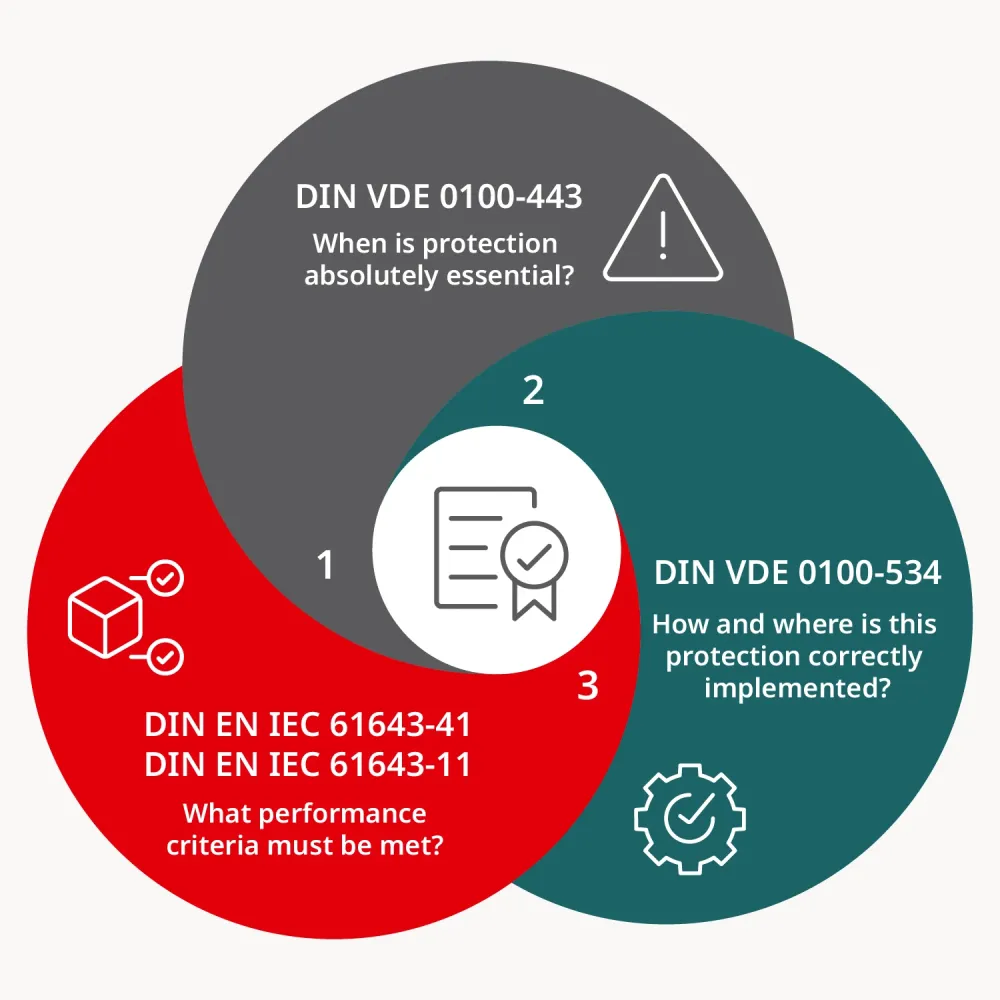
The three key normative areas at a glance
Increasing electrification is making electrical systems more vulnerable. As a result, surge protection is often a necessary part of standard-compliant electrical installations.
How standards relate to each other in surge protection
A standard-compliant protection concept can only be achieved through a combination of several standards. They define when surge protection is required, how SPDs are installed, and what requirements the products used must meet.
DIN VDE 0100-443 sets out the need for surge protection. DIN VDE 0100-534 describes the selection and installation of SPDs. DIN EN 61643-11 for AC and DIN EN IEC 61643-41 for DC define the requirements for surge protective devices.
The figure shows how these three normative areas relate to each other and together form the basis for effective surge protection.

Mandatory: When is surge protection required?
Whether surge protection is required is assessed on the basis of the entire system. The obligation to provide surge protection does not automatically apply in every case, but it does become relevant when certain conditions are met. DIN VDE 0100-443 specifies when measures to protect against transient overvoltages are required.
Typical evaluation criteria include:
- Type and use of the electrical system
- Possible consequences of failure
- Supply situation, e.g. supply by overhead lines
- The presence of an external lightning protection system
- Protection of sensitive electrical and electronic equipment
Special consideration for buildings with an external lightning protection system:
If a building is fitted with a lightning protection system, the requirements of the DIN EN IEC 62305 series of standards must also be taken into account. In particular, DIN EN IEC 62305-4 describes measures for protecting electrical and electronic systems and may require the use of Type 1 SPDs.
Reasons that make it mandatory:


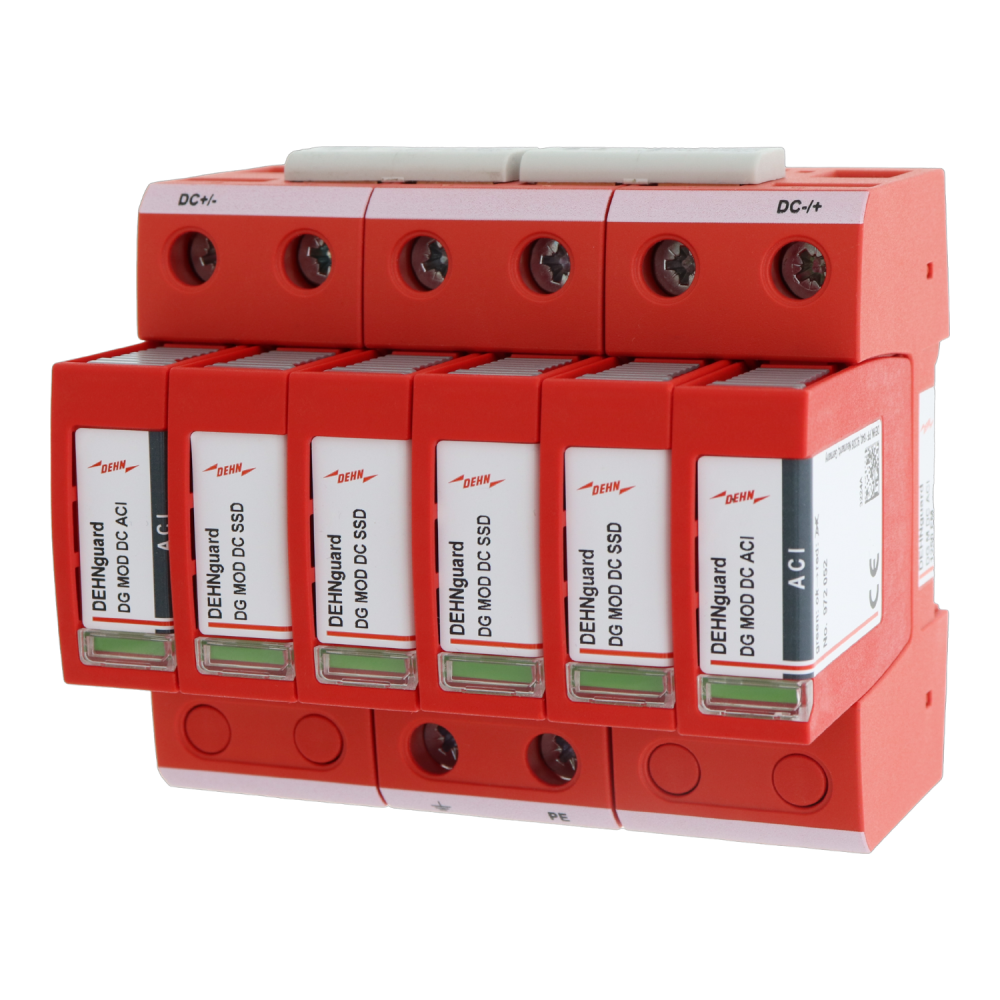
Installation: what's the right way to implement surge protection?
DIN VDE 0100-534 forms the basis for correct selection and installation of surge protection devices (SPDs). However, simply installing an SPD is not enough – what matters is whether the arrester is compatible with the system and the mains. That's why selection and installation must always be considered in conjunction with one another.
The following parameters must be taken into account for implementation:
• Voltage protection level (Up)
• Discharge capacity (In, Iimp)
• Short-circuit withstand capability (ISCCR)
• Connection conditions
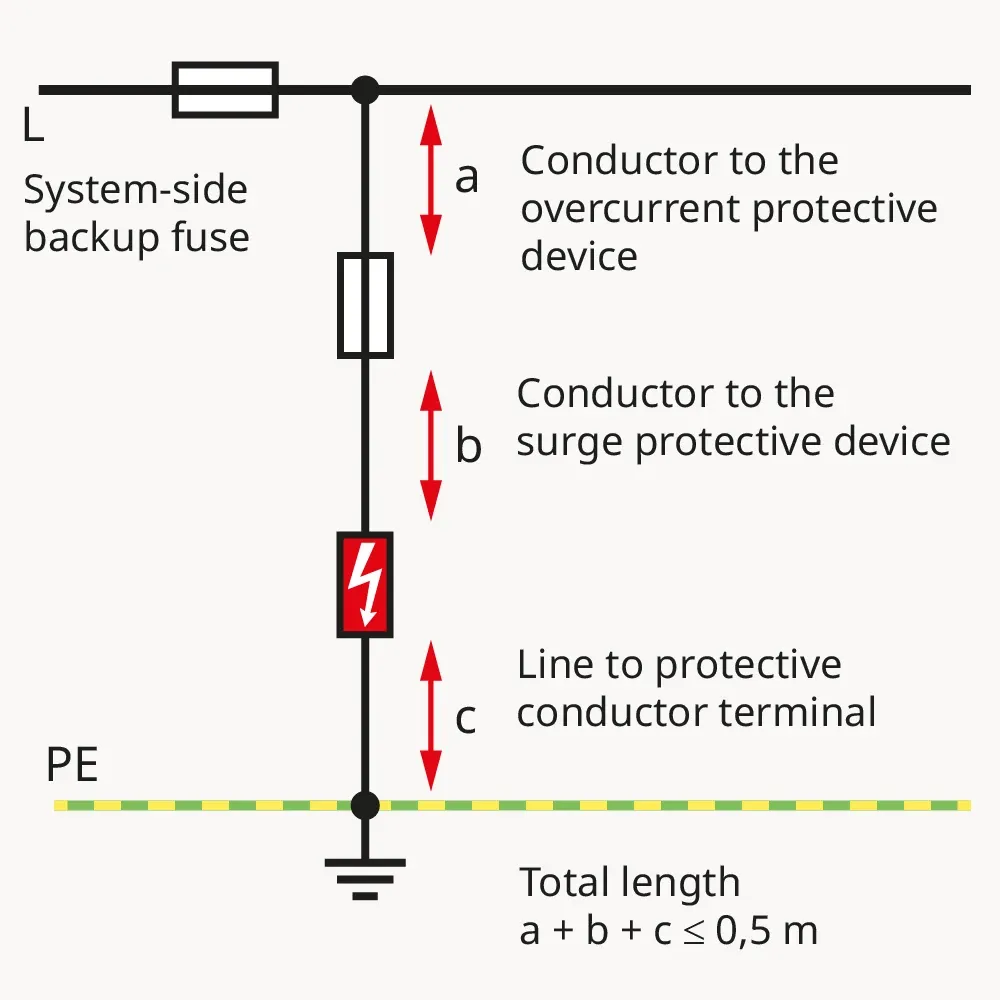
In depth: DIN VDE 0100-534 selection criteria
The selection depends on the specific mains conditions and the requirements of your system. Important parameters are the voltage protection level (Up), the maximum continuous operating voltage (Uc), the discharge capacity (In, Iimp) and the short-circuit withstand capability (ISCCR). Coordination between the various SPDs is also essential.
The voltage protection level Up of an SPD must not exceed the rated impulse withstand voltage Uw of the equipment to be protected. It is therefore recommended to allow a sufficient margin in relation to the maximum permissible impulse voltage. Yet the voltage protection level alone is not the decisive factor. Cable lengths also affect the actual effective voltage protection level Up/f at the terminal equipment. Short connecting cables improve the effectiveness of surge protection.
The maximum continuous operating voltage Uc must be at least equal to the values specified in DIN VDE 0100-534. These values depend on the type of system (TN, TT or IT system) and the connection point.
The choice of SPD type depends on the installation location.
- Type 1 in the presence of lightning protection or power supply via overhead lines
- Type 2 in the distribution board or at the building entry point in buildings without external lightning protection
- Type 3 close to the equipment
The protective effect depends not only on the type of SPD, but also on the interaction of the system as a whole.
The short-circuit withstand capability must be at least equal to the maximum short-circuit current expected at the connection point.
Every SPD that is installed must be protected against short-circuit currents. This protection can be provided internally (integrated into the SPD) or externally (using a separate fuse). The rating of an external backup fuse must comply with the manufacturer's specifications and maximise the impulse durability of the entire SPD combination.
Important for planning: An external protective device increases the effective voltage protection level (Up/f), whereas this is already taken into account with internal protection. In the event of a fault, SPDs themselves can become a hazard, as their internal thermal disconnectors are often not designed for high short-circuit currents.
The following cable cross-sections are required by the relevant standards: For Type 1 SPDs, minimum cross-sections of 6 mm² of copper are required; for Type 2 SPDs, a minimum of 2.5 mm² of copper is required.
With conventional protective devices, cross-sections of up to 50 mm² may be required, depending on the backup fuse.
In arresters featuring ACI technology, the backup fuses are integrated, and 6 mm² (Type 2) or 16 mm² (Type 1) is always sufficient.
Product requirements: safety as per DIN EN 61643-11 and DIN EN IEC 61643-41
Both standards set out the requirements for surge protective devices for AC and DC. They define key product features that you need to take into account when making your selection.
The short-circuit withstand capability is the maximum prospective short-circuit current of the electrical network for which the SPD, together with its disconnectors, is rated. The standard-compliant value must be at least equal to the prospective short-circuit current expected at the connection point.
External fuses must have a sufficiently large rating so that they don't trip in the event of normal surge currents. As a result, they often react slowly or not at all to low fault currents. SPDs can become overloaded before disconnection occurs.
This results in high energy input, potential equipment damage and risks to the system.
Simply installing surge protection does not mean that it's suitable for the system and implemented in accordance with the relevant standards. Standards provide the framework. Quality is achieved through correct selection and implementation,
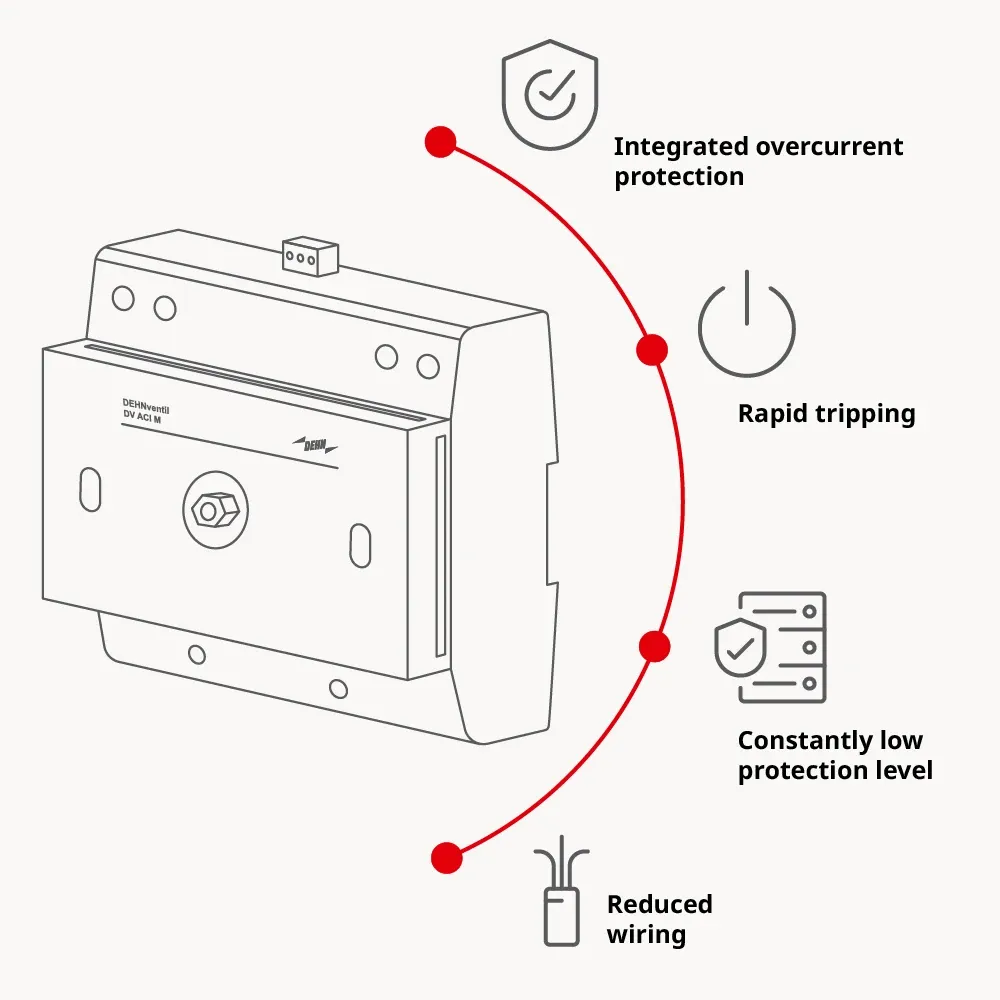

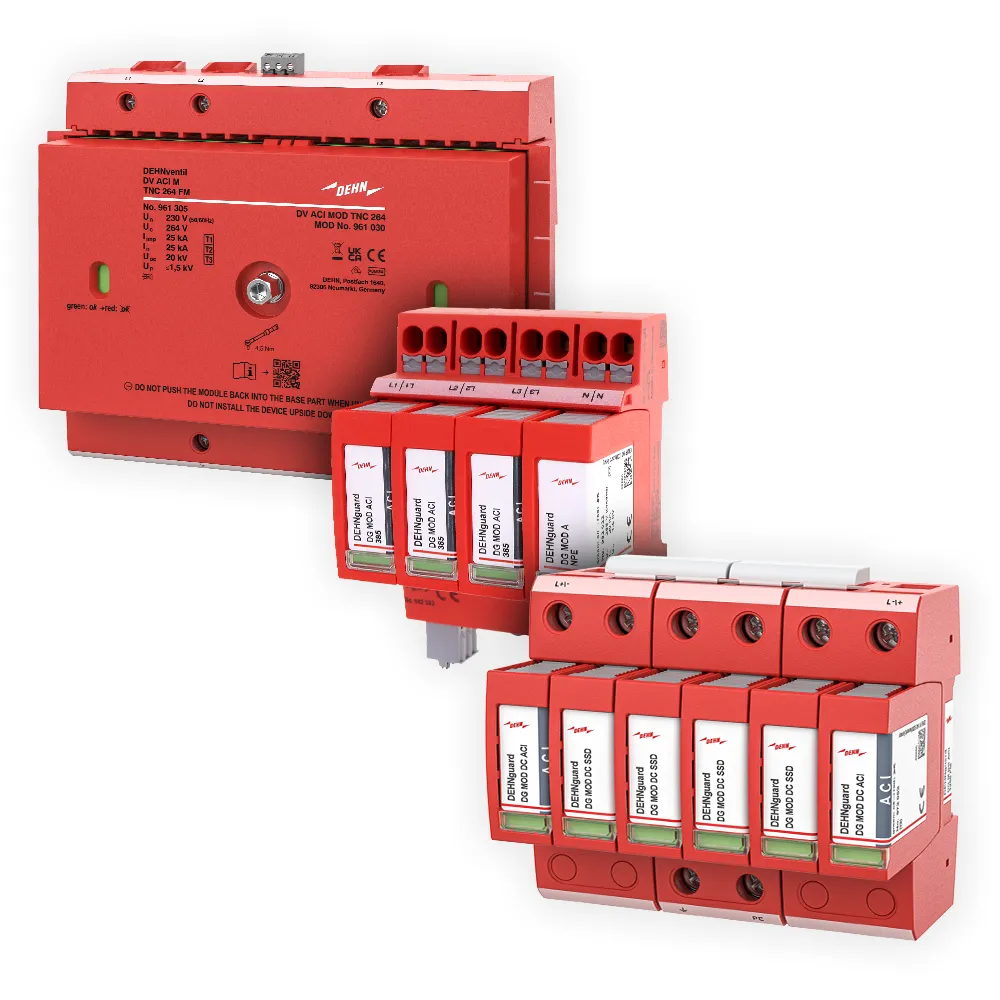
Surge protection with no external backup fuse
Standard-compliant surge protection requires careful coordination of the protection concept, installation and product. Integrated solutions such as ACI bring these requirements together in a single system. The overcurrent protection is integrated directly into the SPD, eliminating the need to coordinate external backup fuses.
FAQs – standards and surge protection
In many cases, yes. DIN VDE 0100-443 specifies when measures against transient overvoltages are required. Of particular importance are the use of the system and the potential consequences of a failure.
Surge protection is mandatory for systems with external lightning protection in accordance with IEC 62305-3!
DIN VDE 0100-534 describes the selection and installation of surge protective devices. Among other things, it covers protection levels, discharge capacity, short-circuit withstand capability and connection conditions.
DIN EN 61643-11 for AC and DIN EN IEC 61643-41 for DC define the requirements for surge protective devices. Important characteristic values are voltage protection level (Up), maximum continuous operating voltage (Uc), discharge capacity and short-circuit withstand capability (ISCCR).
The cable cross-section has a direct impact on the safety and functionality of the surge protection. Only adequately dimensioned conductors can dissipate lightning and fault currents without causing critical thermal or mechanical stresses.
Integrated overcurrent protection makes sense when the aim is to reduce planning complexity and avoid additional components. It can simplify the coordination of external backup fuses and maintain a stable protection level.

Your next steps
Understanding standards and implementing protection concepts correctly
Standards provide the framework. Reliable implementation is achieved through correct selection and application.
Check the requirements for your system and ensure that your surge protection is designed in accordance with the relevant standards – from your obligations to installation and product selection.
Compare protection concepts and avoid common planning mistakes.
Note: Only the full standard documents are authoritative in terms of providing binding information.
Downloads
ACI-Technology
An innovative design concept for SPDs
ACI-Technology
Surge protection with no external backup fuse
ACI Technology
Hidden Dangers: How to protect your installations effectively