Surge protection with ACI technology: knowledge for planning engineers and experts
Technical background on ACI technology, TOVs, selectivity, cable routing and SPD installation.
From TOVs and broken neutral conductors to selectivity and choosing the right type of SPD: this page brings together technical background information, expert answers to frequently asked questions and in-depth information on modern surge protection using DEHN's ACI technology.
- ACI technology
- TOVs & broken neutral conductors
- Selectivity
- Type 1–3 SPDs



Key questions at a glance
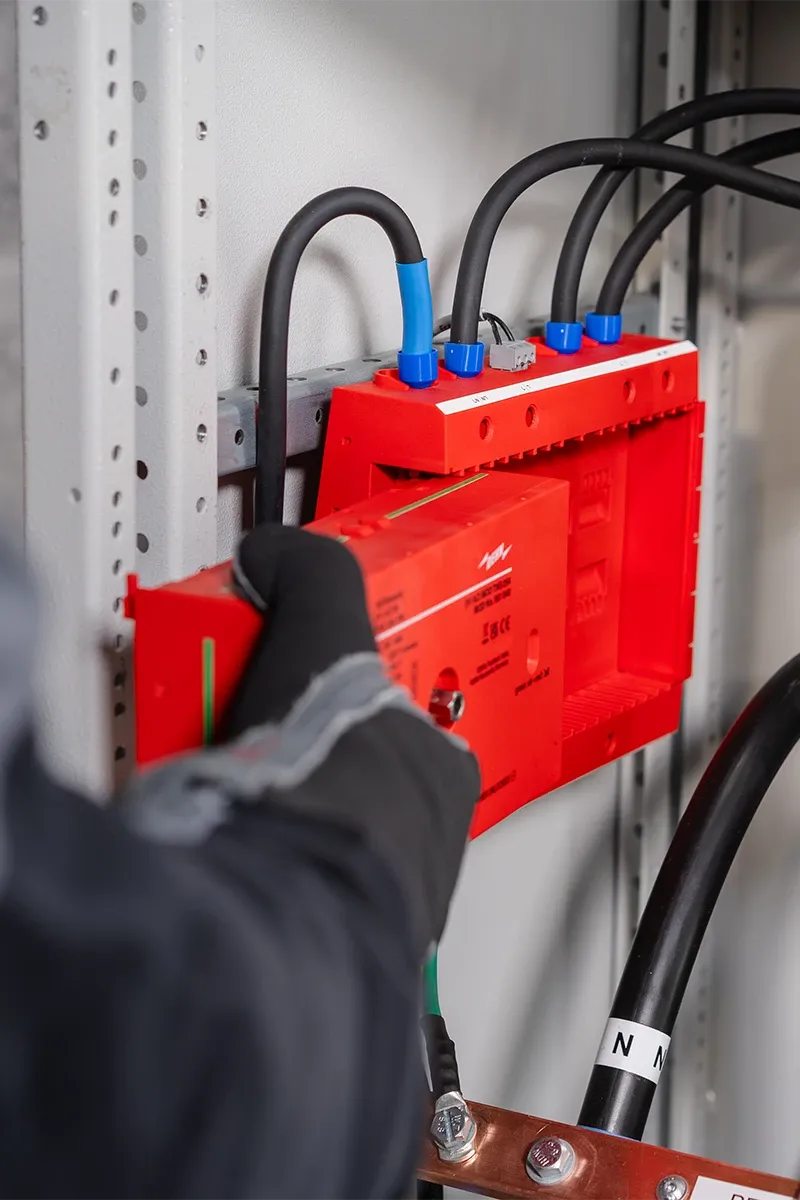
ACI (Advanced Circuit Interruption technology) integrates overcurrent protection into the SPD itself. This eliminates the need for an external backup fuse, prevents any protection gaps and keeps the protection level consistently low.
A protection gap arises from a conflict of objectives in external overcurrent protective devices for SPDs. Overcurrent protective devices must have a sufficiently large rating so that they do not trip in the event of surge currents. However, this makes them too sluggish for small yet destructive fault currents from ageing varistors, which can lead to high energy dissipation and a fire hazard within the SPD.
TOVs (temporary overvoltages) are power-frequency overvoltages that persist for extended periods. One potential cause is a broken neutral conductor.
Selectivity means that, in the event of a fault, only the protective device closest to the fault trips, while upstream protective devices remain unaffected. The objective is to avoid unnecessary system downtimes; the SPD protection must not trip the main upstream protection. ACI technology offers selectivity of 63 A gG (for Type 2) and 100 A gG (for Type 1) and reduces the planning complexity.
The cable routing is crucial, as inductive voltage drops in the connecting cables increase the protection level (Up) of the SPD and therefore reduce the protective effect for terminal equipment. The cross-sectional areas must be able to withstand the short-circuit current load (e.g. 6 mm² of copper for Type 1, 2.5 mm² of copper for Type 2).
For surge arresters featuring ACI technology, cross-sectional areas of 16 mm² for Type 1 and 6 mm² for Type 2 are sufficient.
When are Type 1–3 arresters used?
Type 1 SPDs are typically installed at the feeding point of the system. They are essential for structures with external lightning protection or power supply via overhead lines. They are designed to safely divert the high currents caused by a direct lightning strike. The most important parameter is the lightning impulse current (Iimp), which must be at least 12.5 kA for class of LPS III/IV and at least 25 kA per path for class of LPS I/II.
Type 2 SPDs are typically installed in the sub-distribution boards of a system. They protect against overvoltages caused by switching operations in the grid or indirect lightning strikes. The nominal discharge current (In) must be at least equal to the values specified in DIN VDE 0100-534 (e.g. 5 kA or 20 kA).
Type 3 SPDs are installed close to the equipment to provide direct protection for sensitive terminal devices. They complement Type 1 and Type 2 SPDs and form the final stage of protection in the surge protection concept.

What does TOV stand for?
TOV stands for temporary overvoltages and refers to temporary power-frequency overvoltages. They can be caused by a broken neutral conductor. TOVs are power-frequency overvoltages that persist for extended periods.
In conventional Type 2 surge arresters, a broken neutral conductor causes the internal disconnector to disconnect the SPD from the mains. In contrast, Type 2 arresters featuring ACI technology can withstand this fault condition and remain safely connected to the mains.
Why do TOVs pose a challenge for SPDs?
TOVs almost always result in the SPD being disconnected, interrupting the system's protection. If any overvoltage events occur before the SPD is replaced, the system will no longer be protected.
How do conventional SPDs behave during TOVs?
Conventional standard surge arresters often respond to TOVs with a 'safe failure', where the device is deactivated. ACI technology, on the other hand, offers high TOV withstand. That means an ACI device can withstand a temporary overvoltage and remain operational, rather than disconnecting from the mains. ACI devices feature galvanic isolation to prevent small fault currents from occurring, or they interrupt larger fault currents quickly and safely.
How can TOV risks be managed?
ACI technology offers enhanced safety in the event of temporary power-frequency overvoltages up to at least 440 V. This high TOV withstand significantly reduces the risk of unexpected system failures caused by unstable mains conditions and enhances operational reliability. ACI closes this protection gap by reliably controlling even small fault currents that may occur during TOVs.
Broken neutral conductor
A broken neutral conductor refers to an interruption or fault in the neutral conductor of an electrical system. This event is one of the primary causes of temporary power-frequency overvoltages, or TOVs.
The consequences of a broken neutral conductor are serious and pose a particular challenge for surge protection:
TOVs and protection gaps
A broken neutral conductor leads to temporary power-frequency overvoltages (TOVs), which may persist for a prolonged period. TOVs can cause fault currents that are too low to rapidly trip an external fuse with a large rating, but are enough to destroy the varistors (MOVs) in conventional surge protective devices.
High energy dissipation and destruction:
Low prospective short-circuit currents, as can occur during TOVs, result in long fuse disconnection times. This results in a very high energy dissipation in the SPD, which can damage the device or even the entire distribution board.
Fire hazard
Without a suitable overcurrent protective device that reacts quickly to this kind of fault current, there is a risk of fire. In the event of a fault, the high energy dissipation can damage the SPD or even the entire distribution board.
How a broken neutral conductor can lead to a protection gap
Temporary power-frequency overvoltages are among the most common consequences of broken neutral conductors. If these fault currents are not detected and limited, the surge protective device, the distribution board and the connected equipment may be damaged.
Selectivity in surge protection
Selective surge protection is crucial for the operational safety and availability of electrical installations. It ensures that, in the event of a fault, only the protective device directly affected trips, preventing unnecessary shutdowns of the entire system. Selectivity between overcurrent protective devices is also a requirement of the DIN VDE 0100-430 standard (Section 434).
In the context of surge protection and overcurrent protective devices, selectivity means that, in the event of a fault, only the fuse directly affected trips.
Selectivity prevents a local fault from causing a total failure of the entire system and ensures that the power supply is maintained in the unaffected areas.
Selectivity between protective devices is a key component of standard-compliant system planning. Only when protective devices are coordinated to work together can faults be effectively contained and unnecessary shutdowns avoided.
Cable routing and cross-sections in surge protection
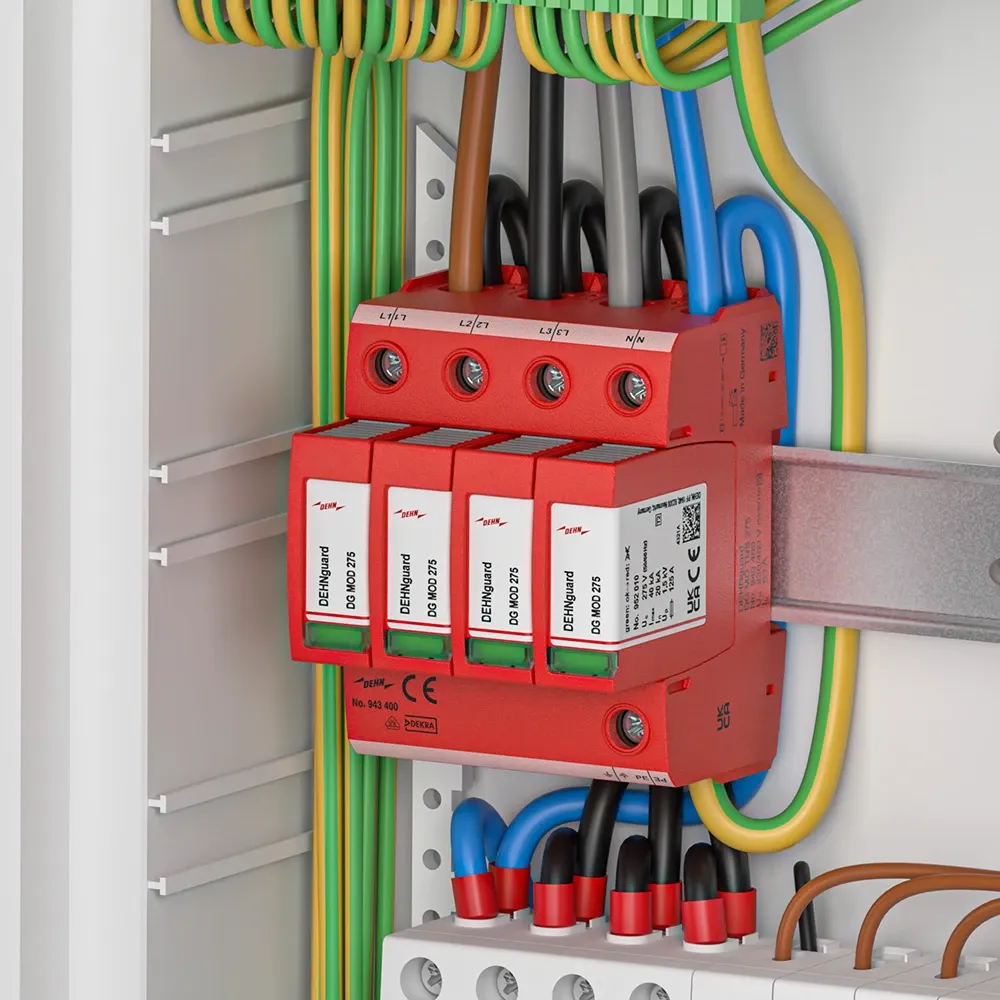
Even if the right surge arresters have been selected and installed, they will only be effective if they are correctly integrated into the electrical system. In particular, the routing and sizing of the connecting cables are crucial factors that have a significant influence on the actual protection level provided at the terminal equipment.
Minimum cross-sections for safe operation
Connecting cables to the SPD must be able to withstand short-circuit currents. Minimum cross-sections are specified in the standards: 6 mm² of copper for Type 1 SPDs and 2.5 mm² of copper for Type 2 SPDs.
Installation for effective protection
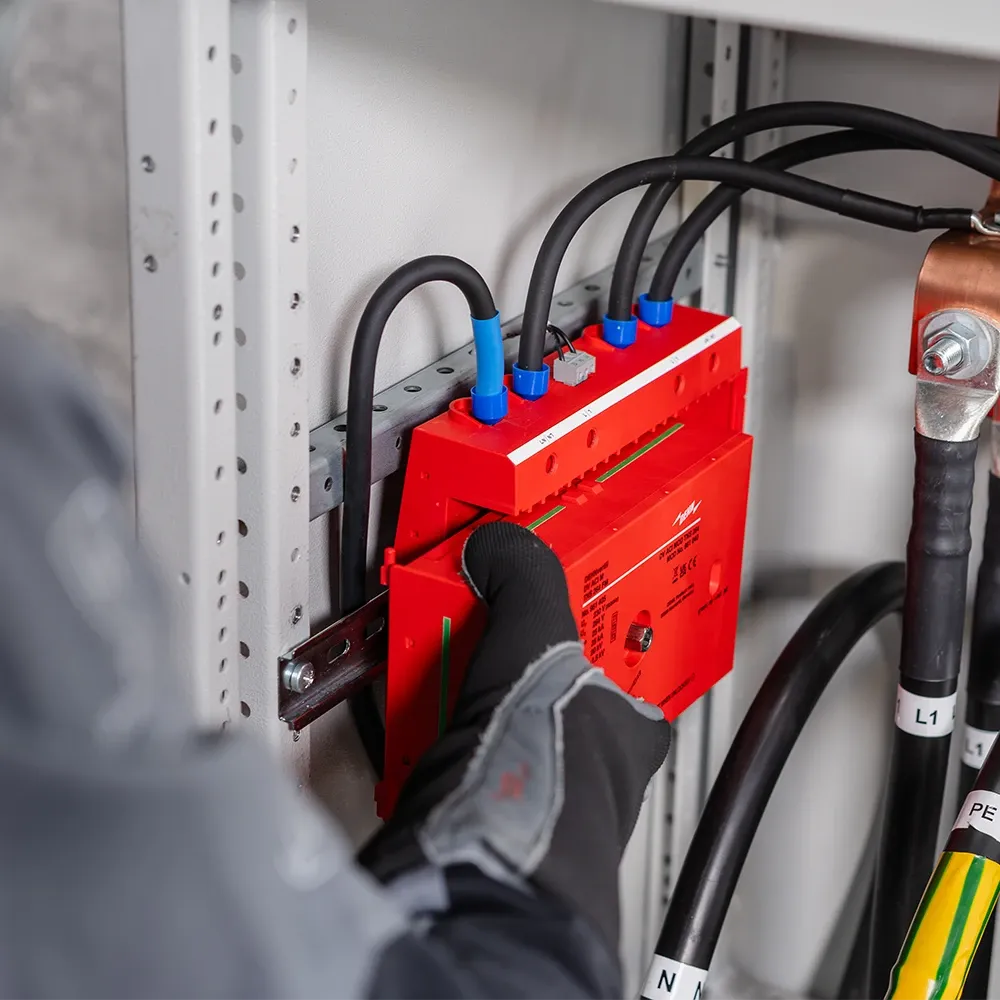
Correct cable routing and minimal cable lengths are crucial for surge protection. Only a precise, standard-compliant installation ensures the required protection level at the terminal equipment and provides optimum protection for the electronics. Poor routing reduces SPD effectiveness.
What is ISCCR?
The short-circuit withstand capability (ISCCR) indicates the maximum short-circuit current that an SPD can safely handle. The specified short-circuit withstand capability (ISCCR) of an SPD must be at least equal to the maximum short-circuit current expected at the connection point. This is crucial for operational safety and the protection of the electrical system.
Glossary
In-depth topics
From protection gaps and ACI technology to standards and applications, the following topics will help you to better understand the technical intricacies and make informed decisions when it comes to planning and installing surge protection.
Why small fault currents can have major consequences.
How integrated overcurrent protection is transforming protection concepts.
How do the safety, planning and protection levels differ?
In which applications does ACI offer particular advantages?
Relevant standards and characteristic values for the selection of SPDs
Downloads
ACI-Technology
An innovative design concept for SPDs
ACI-Technology
Surge protection with no external backup fuse
ACI Technology
Hidden Dangers: How to protect your installations effectively